
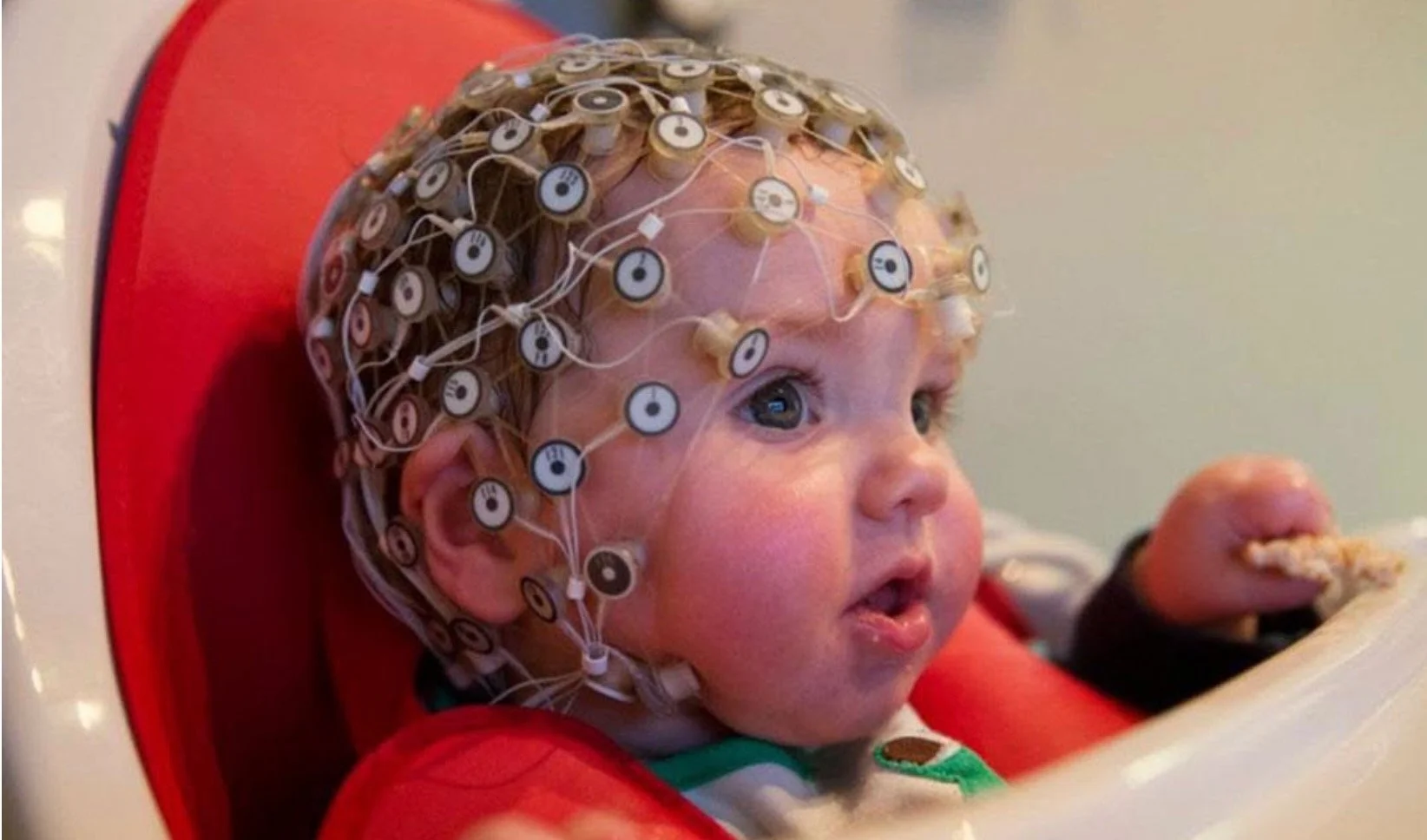
Photo, New Scientist
.A newborn turns toward a familiar voice. We can see the movement, but we cannot ask the baby what hearing that voice is like.
Molly Schayot, an AMI 0-3 Trainer at MINT, describes observation as "the ability to use our senses to take in our surroundings." Scientists can also measure a baby's movements and brain activity. The harder task is working out what those measurements tell us about experience.
In a 2025 scientific review published in the peer-reviewed journal Acta Paediatrica, Joel Frohlich and Tim Bayne examined studies of infant brain activity and behavior for signs of conscious experience. They brought together evidence from brain networks, attention, the combination of sight and sound, and responses to unexpected sound patterns. No single measure can tell us what a baby experiences. Taken together, the findings lead the authors to conclude that consciousness is likely present by five months, possibly earlier.
1. A baby’s attention follows a different style
When two images appear in quick succession, five-month-olds need more time than adults to detect the second. Researchers call this temporary difficulty the attentional blink. In a study discussed by the review, it lasted about 1.2 seconds in five-month-olds, compared with 0.2 seconds in adults.
The result suggests that visual attention develops at a different pace. In her MINT course, Molly describes how she approaches the child's pace during everyday care:
"We're moving slowly. We're narrating the steps of our activities, and we are doing all of that with joy and with patience."
Her words describe how an adult works with a child; the experiment measured how infants detected images.
2. Some brain networks are present around birth
Scans of newborns show organized patterns of activity across brain regions, called functional connectivity. The review identifies the default mode, dorsal attention, and executive control networks. A relationship between the first two is associated with consciousness in adults, though these networks are still developing in infants.
"Their brains function quite differently from ours," Molly tells students in her AMI 0-3 course at MINT. The scans suggest that some brain organization associated with awareness is present around full-term birth. They cannot tell us what a baby feels.
3. Attention involves more of a young baby's brain than we might expect
A baby looks toward something that catches their attention. In studies of infants around three months old, this response recruits networks involving the front of the brain. Researchers call it stimulus-driven attention. The networks have more precise names: frontoparietal and cingulo-opercular.
Attention offers a clue to awareness, but it can also occur without conscious experience. Regarding observation, Molly cautions:
"It's really important when we're observing their work that we're not attributing a goal that we don't necessarily understand."
A baby's look and brain response tell researchers where attention goes. They cannot tell them exactly what the baby experiences.
4. By about five months, babies combine what they see and hear
Watch someone's lips form "ga" while you hear "ba," and you may perceive a third sound, "da." Researchers have found a similar effect consistently in infants from about five months of age. Because babies cannot say what they heard, researchers study how they respond to the sounds.
This is multisensory integration. The particular result is called the McGurk effect. Adult experiments have linked this effect to conscious perception, making the infant finding another clue about early experience.
In her MINT course, Molly turns to what adults can offer:
"Our job in these first three years is to give them lots of opportunity to collect real sensorial experiences."
Her quote concerns the child's opportunities to explore. The experiments examine how infants bring sensory information together.
5. Newborn brains respond when a sound pattern changes
Researchers play the same short sequence of tones repeatedly, then change the sequence. Sensors detect a response in the newborn's brain. In adults, a related response often appears about 300 milliseconds after an unexpected event and is called P300. The newborn response comes later, so the review calls it P300-like.
Molly describes children's interest in familiar patterns in daily life:
"Young children build that order through their experiences in the environment. They're looking for order all the time."
The sound experiment measures a narrower response: the newborn's brain registered a change. It cannot tell us whether the baby felt surprised.
What do these findings mean, together?
The review's case rests on several clues pointing in a similar direction: brain networks, attention, combined sensory information, and responses to sound patterns. In this 2025 follow-up, Bayne and Joel Frohlich conclude that conscious experience is likely present by five months, possibly earlier. They cannot say exactly when it begins. Evidence about experience before birth remains particularly uncertain.
Molly says that working with young children calls for "a genuine and joyful curiosity about the life of this child." The research gives us more to be curious about and better ways to investigate. It also gives us reason to be careful about what we claim to know. We can watch a baby turn toward a voice. What that voice is like for the baby is still a question worth asking.
Read the research: Bayne and colleagues, 2023 and Frohlich and Bayne, 2025.
Frohlich, J., & Bayne, T. (2025). Markers of consciousness in infants: Towards a 'cluster-based' approach. Acta Paediatrica, 114(2), 285–291. https://doi.org/10.1111/apa.17449
Recommended by Johnny Boucher
Discover more articles, podcasts, videos, and features selected by MINT trainers and staff for the Montessori community.
Visit the MINT Reading Room
